The Best Drills for Defenders
As a rising senior in college, I understand how difficult it can be for defenders to train alone during winter or summer breaks. Attackers can spend hours working on dodging and shooting, whereas defenders can’t do as much without another player.
However, one of the most important things a defender can work on during these breaks is footwork and all it takes is some cones and some free space. Footwork may seem repetitive, but as a defender you genuinely can never do too much footwork. While in the moment it may seem frustrating not being able to play live defense against an attacker, the habits and skills learned from doing footwork translate directly from your backyard to the field.
Here are some of my favorite solo footwork drills that prove you don’t need an attacker to be a better defender:
Box Drill
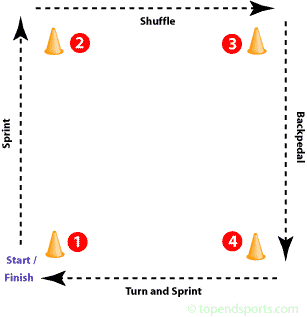
Box Drill
This footwork drill can be done with or without a ball. Place the cones about five yards apart. Start at the bottom left cone, sprinting to the top left, shuffling to the top right, backpedaling to the bottom right, finally turning and sprinting through the bottom left cone. I usually do this four times starting on the bottom left and four times starting on the bottom right.
A couple key things to remember;
Break down your feet from the bottom left to top left cone. Mimic as if you are actually playing defense recovering to the girl on the top left cone. In a game, you wouldn’t sprint at your attacker and then stop right in front of her, so don’t train that way. Sprint than start to athletically break down your steps before initiating the shuffle.
Staying low! One of the most important things to remember as a defender. Running through this variation of footwork should kill your quads because you are low the whole time. This means an athletic stance, specifically on the shuffle. Widen your feet a bit, bend your knees, and focus on not leaning your upper body forward. Stay straight up while having a bit of bend.
Stay tight to the cones. The point of the cones isn’t just to be a marker of where to stop running. You want to focus on clean and direct steps. The sloppier and farther off from the cone you run, the more likely you are to overplay your attacker in a game. Stay close to the cones and you will have cleaner footwork in a game
I recommend using a stick regardless of ball to focus on athletic positioning and keeping your arms out in front of you mimicking playing defense. If you want to incorporate a ball, start on the top left cone, place the ball on the top right, and go through the cones in reverse. Back pedal to the bottom left, shuffle to bottom right, sprint to the top right, and run through the groundball.
I’m probably over explaining this, but it's because I genuinely believe this is one of the most valuable footwork drills for defenders. I remember doing this in middle school, and I still do this all the time because you cannot grow out of it; you can only get better at it.
Box Drill Variation 2
We can utilize this same box to run through another variation of footwork. This drill can be done with or without a stick, but without a ball. Start at the bottom right cone, shuffle to the bottom left cone, then explode off that cone sprinting diagonally to the top right cone, and end with a shuffle to the top left. Walk back to the beginning and do 4-6 reps before switching sides.
A key to this variation is the breaking down of our feet. You want to reach top speeds from the bottom to top cone sprint; however, emphasize your approach to the top cone. Act as if you a running up to an attacker in a game and focus on slowing down your approach and use lots of little steps as you do to stay balanced and ready for your attacker to make her move.
Arrow Drill
This drill can be done with or without a stick and with no ball. I do however highly recommend doing with a stick to focus on our arm positioning. Place four cones in the shape of an arrow; the lowest cone and highest cone should be about five yards apart. The two on the sides are about three yards from the middle cone. Start at the bottom cone and sprint to the top cone. Then, drop step to your left, and shuffle to the side cone. Do 4-6 times on your left before switching to your right.
Main emphasis here is the breakdown of steps before the drop step. Another huge emphasis is the positioning of our arms. After our drop step, we are mimicking driving an attacker out of the 8 meter, meaning we want our arms up. You do not want them to be completely straight, so maintain a slight bend and mimic the action of contact defense.
It can be extremely helpful to have someone playing offense in this drill. Even if they don’t play lacrosse, they can jog from cone to cone while you make contact, just to focus on staying clean and disciplined. It can, however, be done alone!
Crash to Groundball Drill
For this drill you want to have three cones in the shape of a right triangle. Start with two cones at the top and one cone at the bottom right. If you are using the photo above, it is the cones numbered 2, 3, and 4. You are going to start at the top right cone with a ball in front of you. Shuffle to top left cone, then drop step and crash to the bottom right cone. After this, sprint to the top right cone and through the ground ball.
You want to remember all the key breakdowns from the drill before, such as staying low and close to the cones. However, let’s also walk through the drop step and crash. In doing this, we are mimicking our adjacent defender being beat and we are crashing to send help. Once you reach the top left cone after shuffling, drop your right foot so your body is at a diagonal. Rather than shuffling, you want to run to the bottom right cone at a diagonal whilst keeping your eye on the ball at the top right cone. Hold out your stick in your right hand as well to mimic crashing with stick.
As soon as you hit that bottom right cone, explode out to the top right cone in a sprint and pick up the ground ball. I usually do 4-6 reps of this before switching the bottom cone to the left side and repeating. This drill is not only beneficial for footwork, but also for learning the proper angles to approaching a crash when you are the direct help. As well as this, it helps with finding and scooping through the ball on the ground after a crash.
Stick Work
One of the most important skills any player can work on by themselves is stick work. All you need is a wall/bounce back and a ball. My go to routine is;
25 dominate hand
25 non-dominate hand
25 one hand (dominate)
25 one hand (non-dominate)
25 catch off side (dominate)
25 catch off side (non-dominate)
25 little hands (dominate)
25 little hands (non-dominate)
25 catch and switch in the air
25 catch and switch with ball in stick
25 behind the back
25 dominate
This routine covers nearly all the most significant stick skills you will likely use in a game. It also emphasizes consistency with the use of both hands. And capping off with the behind the back will build confidence and work on controlling the ball in your stick, which translates to all other stick skills.
Something else I like to add as a defender (specifically only on a wall) is throwing the ball low against the wall, so it bounces back. Catching the ball off the bounce is a great way to start to work on controlling ground balls whether they are only on the ground or bouncing toward you.
As defenders, it can be easy to assume improvement only comes from live reps. And although live reps are crucial, they are not the only way to become a better player. Sure, these drills aren’t flashy or exciting. But they are the drills that help build habits you rely on when doing these live reps in games. All you need is a wall, some cones, and a stick. When you step up for a one v one in a game, you’ll thank yourself for the hours of repetition you put in beforehand.
Image citaition: Wood, R. J. (n.d.). Box Drill Calculator – 4 Cone Agility Test Results & Standards. Topend Sports. https://www.topendsports.com/testing/tests/box-drill.htm
